When it comes to teaching math to your kindergarten students there are so many possibilities to make math fun and engaging. At these younger levels it’s easy to include a variety of manipulatives to help students “see” the concepts they’re learning.
Making math fun and engaging for your young students will give them the confidence they need to enjoy math now and in the future.
Here are some tangible and practical ways you can make math fun for your students:

Use Count & Clip Cards
These cards are simple to use and great for math centers. Students simply count how many objects are on each card and use a clothes pin to clip the number that matches.

More Ideas:
- I like to use count and clip cards to work on math facts too. It gives students a visual of what it looks like to add more to a certain number.
- Change up the activity by using different manipulatives. Instead of clothespins, cover the correct number with mini erasers or other small tokens. If your students love dry erase markers, use them to circle the number, just be sure to laminate the cards first or put them in a dry erase pocket.
Solve the Room
This is another favorite. Much like “Write the Room,” students walk around the room finding task cards with different math problems to solve and write the answers on their recording sheets.
Solve the Room is great to use as a review or to practice recently learned concepts. We use the Solve the Room activities weekly because they are such a fun way to practice math. With new concepts being learned the task cards change and keep the activity interesting and fun.
Other Ideas:
- If walking around the room isn’t an option for your classroom, give each student one card and have them pass them to each other as they answer them.
- You could also use it as a math center for students that finish their work early.

Follow these simple steps to try “Solve the Room” activities with your students:
- To make your own “Solve the Room” cards simply label the corner of index cards with letters. I usually use letters A-L, because I have found 12 task cards to be a good number. Too many can become overwhelming and too little isn’t challenging enough.
- Next write a math problem or equation on each card.
- Then place the cards around the room where they can be found.
- Have students find the cards and write the answers on their papers. You can use special recording sheets or have students letter their papers.
We enjoy “Solve the Room” so much that we do it weekly. You can buy already made Solve the Room activities. They are included in my math activities on TpT.
10 Frames
Another easy way to teach number recognition and help students visualize how much a particular number looks like is 10 Frames.
Ideas to use with your 10 Frames:
- Mini-erasers (They are just so cute and fun!)
- Pom-poms
- Small Tokens
- Bingo Chips
- Playdough – Using playdough adds an extra sensory element and the students can roll the playdough into balls to mark the squares on the 10 Frames.

Don’t forget ten frames aren’t just for counting. You can use them to teach addition and subtraction too. Sometimes you’ll have to use additional 10 frames for numbers larger than 10, but it really helps students see how adding more or taking objects away changes the number.
100 Charts
It’s funny to me how sometimes the simplest things can be really enjoyable and engaging for kids. We have just a normal 100 chart that my boys choose to work on often. It could be because they get to use mini erasers to cover the numbers as they say them, but whatever the reason I’m not complaining.
100 charts help greatly with learning to count to 100. Plus they add the visual element that is needed for children to actually know what that written number looks like instead of just rote counting.


Number Puzzles
Help your students learn number sequences with number puzzles. Number puzzles are picture cut into strips. Then each strip is numbered. Students put the strips in numerical order to put the picture back together
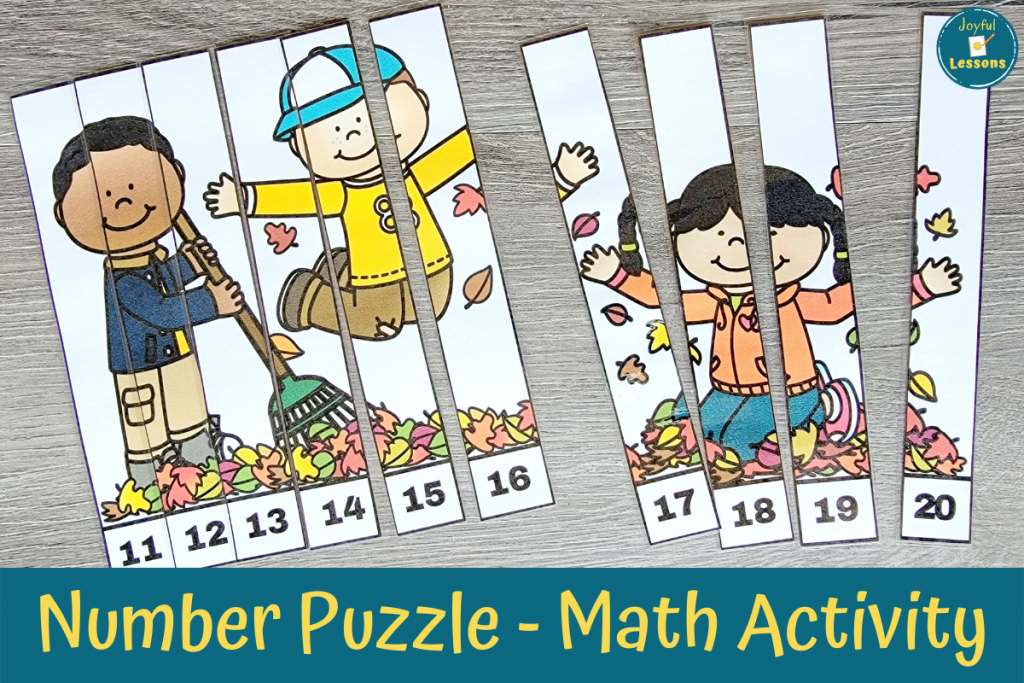
Number puzzles are excellent to use in math centers. They teach number recognition and number sequence. Use them to teach numbers 1-10 or even skip counting.
Pattern Block Activities
Using pattern blocks as hands-on manipulatives is a good way to teach shapes, problem solving, and spatial awareness.

Here are a few ways to use these fun, colorful resources in your classroom:
- Give students the opportunity to see what designs they can make from the shapes.
- Set up a center with pattern block activity cards and pattern blocks. Let your students explore the different objects that can be made with the shapes.
- Complete worksheets with the blocks documenting how many of a certain shape was needed to complete the picture.
Graphing
Teaching students how to chart data at a young age will only make it easier for them as they get older. Have them look at a picture with various items and color in that number of squares on a graph for each item.

Other Ideas:
- Roll dice a certain number of times. Then mark the number or picture that is rolled.
- Instead of coloring the squares on a bar graph, students can use Mini-erasers, Pom-poms, or bingo chips to mark each square. Using tangible items really does make activities more enjoyable.
What are some ways you have found to make math fun for your students?
I would love for you to message me on Instagram or email me some of your Ideas. I’m always looking for more ideas to try with my little guys!